Summary The Shallows by Nicholas Carr pdf
Quotes from The Shallows by Nicholas Carr pdf
review The Shallows by Nicholas Carr pdf
Book summary: The Shallows
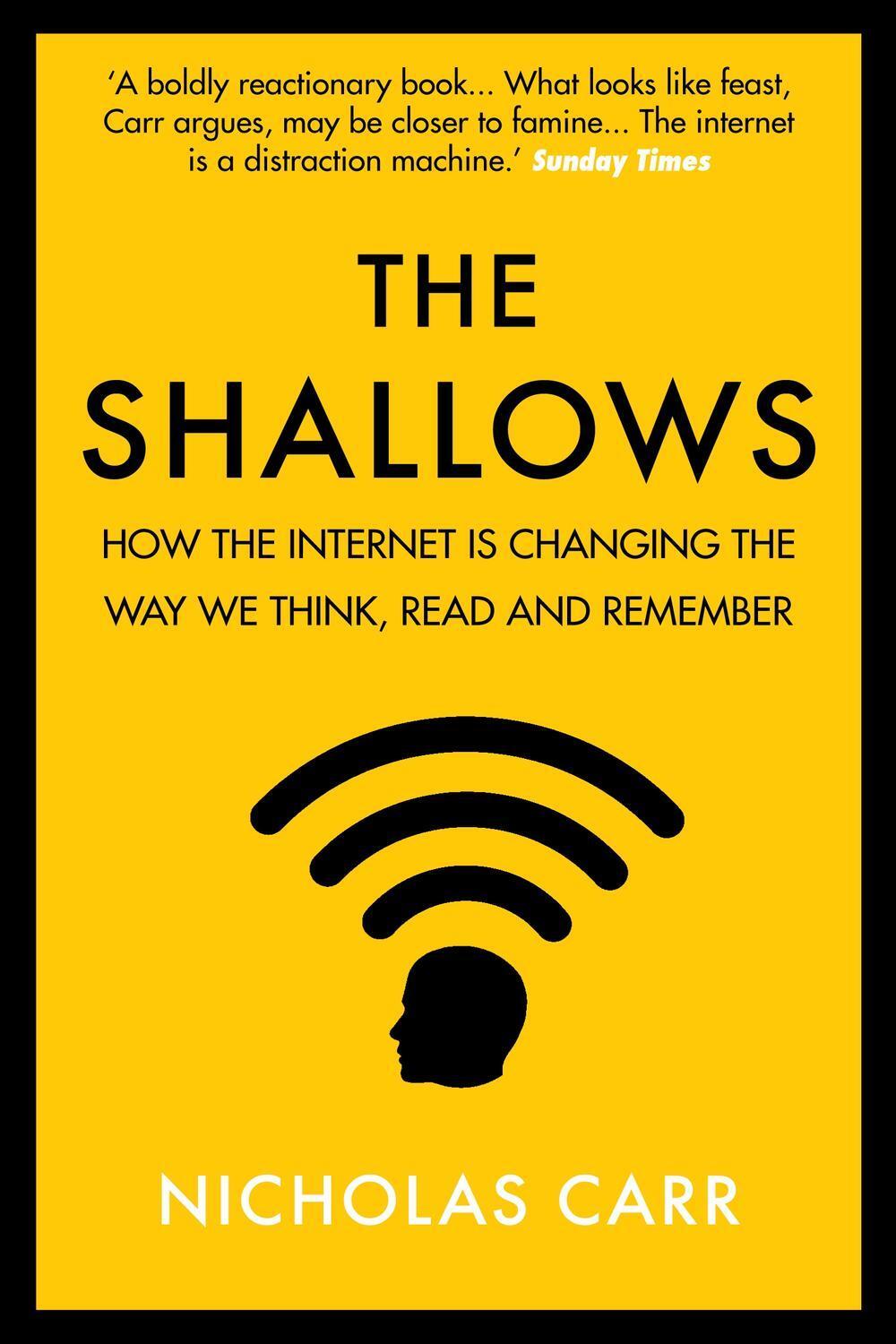
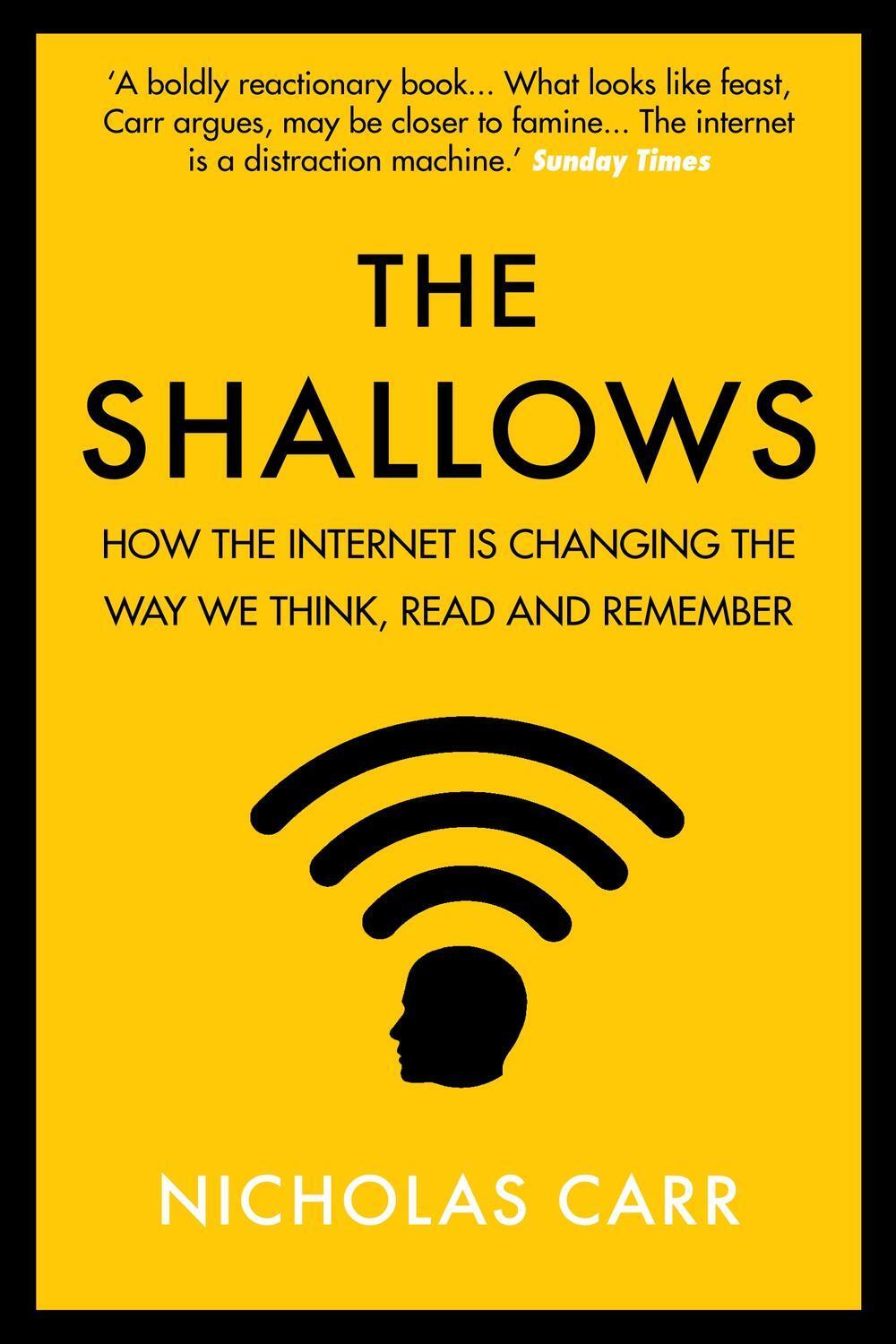
Nicholas Carr asks a question beyond online content: what does the form of a medium do to the way we think? The Internet rewards speed, links, alerts, and switching, so users become skilled at scanning and rapid selection. Those skills are useful, but a cost may appear when reading a long text or following a sustained argument. Carr begins with his own difficulty staying with books, then examines the history of writing and printing to show that tools do not only carry information; they encourage cognitive habits. He does not claim that every user inevitably becomes shallow, but that distraction becomes a default requiring conscious resistance.
The argument draws on neuroplasticity: brains change with repeated activity. If interruption and novelty seeking are rehearsed, quick switching may improve while sustained attention becomes harder. Working memory is limited. Every link, decision, and notification consumes part of it, leaving less capacity to connect ideas and transfer material into long-term memory. Readers can therefore leave an information-rich page remembering surprisingly little. Paper is not magical, but a calm sequential design demands fewer decisions than an interface that continuously opens alternatives.
Deep reading sits at the heart of the book. Extended silent reading developed an interior space for reflection and the tracking of complex thought. Scanning can capture words and headings without reconstructing the underlying architecture. The network also provides enormous access, collaboration, and immediate research, which Carr does not simply deny. The important choice is not paper versus screen but medium matched to task: the Web excels at discovery and comparison, while deep comprehension often requires removal of links and alerts and a period that does not demand response.
Carr also examines outsourcing memory to search engines. Knowing information is available may encourage people to remember where it is rather than what it says. That can be efficient, but it becomes dangerous if internal knowledge is too weak to support judgment and synthesis. An argument cannot be built from facts that never remain in memory long enough. The book also warns that attention-based companies benefit from repeated engagement. Their interest in clicks does not always match the user’s interest in concentration, so interface design is not neutral.
Some conclusions were stronger than the early evidence available at publication, and later research offers a more complicated picture involving individual, task, and usage differences. Carr can sound nostalgic for book culture and understate educational opportunities created online. Yet he identified the attention economy early. The reasonable response is not fear of technology: separate deep reading from alert environments, keep notes, use screens for tasks they serve well, and practice one daily period in which boredom does not trigger immediate switching.
A clearer view of “The Shallows” emerges when the summary is organized around four connected themes: «Media train habits», «Working memory is limited», «Internal knowledge still matters», «Match tool to task». In theme 1, Rapid switching becomes easier as an interface repeatedly rewards it. In theme 2, Links, choices, and alerts consume capacity needed for comprehension. In theme 3, Finding information is not the same as possessing a structure for judging it. In theme 4, Use the Web for exploration and protect a separate environment for deep reading. These themes are not isolated rules. They are lenses for understanding the argument, the characters’ movement, and the consequences the work asks readers to consider. While reading, it helps to record the central claim in each part, the example supporting it, and the question still unanswered, then compare those notes with personal experience or an independent source whenever historical or scientific facts are involved. This prevents an attractive phrase from becoming a universal truth and separates what the author actually states from what the reader infers. With a practical nonfiction book, one idea can be tested for a week, with results and obstacles recorded before the method is adjusted; trying everything at once makes evaluation impossible. With fiction, the equivalent test is to track changes in character, the narrator’s reliability, and whether the ending answers the tensions the plot created. A final three-sentence note—main insight, strongest objection, and one action or question worth pursuing—makes the reading easier to retain without exaggerating the book’s promises or dismissing its value. The book then becomes the beginning of a revisable conversation shaped by context, goals, and edition, not a closed recipe or a collection of quotations.
Book and author information
Author: Nicholas Carr, an American writer on technology and culture.
Full title: The Shallows: What the Internet Is Doing to Our Brains.
First published: 2010; an expanded tenth-anniversary edition appeared in 2020.
Length: varies, with some expanded English editions around 320 pages.
Key ideas
Media train habits
Rapid switching becomes easier as an interface repeatedly rewards it.
Working memory is limited
Links, choices, and alerts consume capacity needed for comprehension.
Internal knowledge still matters
Finding information is not the same as possessing a structure for judging it.
Match tool to task
Use the Web for exploration and protect a separate environment for deep reading.
Review and rating
Editorial rating: 4.3 / 5.
A prescient, powerful essay on reading history and the attention economy whose central questions have become more urgent.
It can simplify paper versus screen, and some scientific claims need newer research. Its framework is stronger than any final verdict.
Frequently asked questions
1. Does Carr say the Internet makes everyone stupid?
No. He says its design trains attention habits that can interfere with sustained thought.
2. Is screen reading always bad?
No. Text type, interface, alerts, and purpose matter more than the material alone.
3. What is the main mechanism?
Repeated switching loads working memory and interrupts the construction of meaning.
4. How can I protect focus?
Disable alerts and reserve periods for one reading or writing task.
5. Is this a pure scientific review?
No. It mixes intellectual history, argument, and science journalism.
"The Shallows by Nicholas Carr pdf ": If it appears on the site in a way that violates copyright, please contact us immediately via the contact form or email to have it removed immediately out of respect for intellectual property rights. Call us: contact@market-books.com
Share the book with your friends


The Shallows by Nicholas Carr pdf
The Shallows by Nicholas Carr pdf مترجم
The Shallows by Nicholas Carr pdf in french
The Shallows by Nicholas Carr pdf en france
The Shallows by Nicholas Carr pdf en français
The Shallows by Nicholas Carr pdf بالفرنسية
The Shallows by Nicholas Carr pdf in English
The Shallows by Nicholas Carr pdf en anglais
The Shallows by Nicholas Carr pdf بالإنجليزية
The Shallows by Nicholas Carr pdf in Arabic
The Shallows by Nicholas Carr pdf en arabe
The Shallows by Nicholas Carr pdf بالعربية
The Shallows by Nicholas Carr pdf in Arabic
The Shallows by Nicholas Carr pdf in English
The Shallows by Nicholas Carr pdf in french
The Shallows by Nicholas Carr pdf in french For free
The Shallows by Nicholas Carr pdf en france For free
The Shallows by Nicholas Carr pdf en français For free
The Shallows by Nicholas Carr pdf بالفرنسية For free
The Shallows by Nicholas Carr pdf in English For free
The Shallows by Nicholas Carr pdf en anglais For free
The Shallows by Nicholas Carr pdf بالإنجليزية For free
The Shallows by Nicholas Carr pdf in Arabic For free
The Shallows by Nicholas Carr pdf en arabe For free
The Shallows by Nicholas Carr pdf بالعربية For free
The Shallows by Nicholas Carr pdf in Arabic For free
The Shallows by Nicholas Carr pdf in English For free
The Shallows by Nicholas Carr pdf in french For free
Books in the same category

Download a book Secrets of the Millionaire Mind pdf

Download a book Pharaohs thieves of civilization pdf

Download a book Act Like a Success Think Like a Success pdf

Download a book The Power of Your Subconscious pdf

Download a book Staying Strong: 365 Days a Year pdf

Download a book The Subtle Art of Not Giving a F*ck pdf



Download a book How to Sell Anything to Anybody pdf







Download the book Full of Emptiness in PDF format

Download the book I Loved and Tomorrow in PDF format

Download the book Know Your Other Face in PDF format










Never Again Will I Be Defeated PDF – Abdullah Mohammed Al-Turki