Summary Blue Ocean Strategy pdf
Quotes from Blue Ocean Strategy pdf
review Blue Ocean Strategy pdf
Blue Ocean Strategy Summary
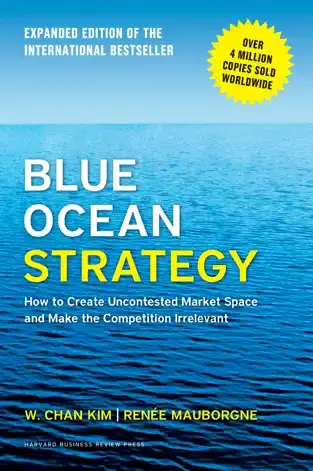
W. Chan Kim and Renée Mauborgne distinguish red oceans, where firms fight over known demand, from blue oceans, where they create market space or redefine an existing industry's boundaries. The water metaphorically turns red when offers converge and growth means taking share through lower prices or more features. The book does not argue that competition can be ignored forever. It aims to make competition temporarily less relevant by producing different value that attracts not only existing buyers but also people who previously rejected the category.
The method's center is value innovation: simultaneously pursuing a leap in buyer utility and a more favorable cost structure. This challenges the usual assumption that differentiation must be expensive and low cost must deliver weaker value. A company may remove elements funded by industry habit but undervalued by customers, then invest in factors that change the experience. The goal is not technology for novelty's sake. People must want to buy, and the organization must deliver profitably. Value without innovation remains incremental, while innovation without value becomes an interesting experiment without a market.
The strategy canvas makes the current situation visible. A team plots the factors on which the industry competes and the level each competitor provides, producing value curves. If a company's curve copies everyone else, a buyer usually has no clear reason to choose it. The goal is a focused and divergent curve expressible through a coherent message. The picture does not replace research. Its factors and scores should come from observing buyers, noncustomers, and actual use rather than relying only on what executives in a meeting room assume people value.
The best-known tool is the Four Actions Framework. Which factors taken for granted should be eliminated? Which should be reduced below the norm? Which should be raised above it? Which should be created because the industry has never offered them? The eliminate-reduce-raise-create grid prevents an “add everything” strategy that inflates complexity and cost. Elimination is not blind economy, however. Removing something essential to trust or safety can destroy the offer. Each choice needs evidence, experimentation, and comparison with the alternatives people use to perform the same job.
To reconstruct market boundaries, the authors examine alternative industries, strategic groups from premium to budget, the buyer chain of user, influencer, and payer, complementary services, functional versus emotional orientation, and trends across time. They also focus on three tiers of noncustomers instead of only loyal users. The useful question is not just why current customers like us. It is why the majority avoids the entire category and which common barrier can be removed without tailoring a separate product to every person.
After the concept comes the strategic sequence. Does it create exceptional utility? Is its price accessible to the targeted mass of buyers? Can cost support profit at that price? Have adoption obstacles among employees, partners, and the public been addressed? Order matters. An impressive product with an unrealistic price or structurally impossible cost is not a durable blue ocean. Execution also requires fair process: explaining the reasoning, allowing meaningful engagement, and making expectations clear. Otherwise the organization may resist from within the strategic change it designed.
A blue ocean does not remain blue forever. Success attracts imitation and changes expectations, so companies should monitor the value curve and renew when convergence begins without abandoning a productive position too early. The book's famous cases and visual tools are compelling, but the cases do not prove that the framework alone caused every outcome. Regulation, networks, capital, timing, and capabilities still matter. Blue Ocean Strategy works best as a map for disciplined questions and tests, not a promise that filling four boxes automatically reveals a market with no competitors.
Book and Author Information
Authors: W. Chan Kim and Renée Mauborgne, strategy professors at INSEAD.
Full title: Blue Ocean Strategy: How to Create Uncontested Market Space and Make the Competition Irrelevant.
Published: first edition in 2005; expanded edition in 2015.
Page count: about 320 pages in the 2015 expanded English edition.
Main Ideas in the Book
Value innovation
Increase buyer utility while improving cost instead of accepting the conventional trade-off.
Strategy canvas
Compare value curves to reveal convergence and opportunities for divergence.
Eliminate, reduce, raise, create
Rebuild competitive factors instead of endlessly adding features and cost.
Follow the strategic sequence
Validate utility, price, cost, and adoption before calling the concept viable.
Honest Review and Rating
Editorial rating: 4.5 out of 5. It offers unusually clear visual language and strong workshop tools for escaping an industry's mental boundaries.
Some cases are selected after success, while a grid cannot replace financing, technology, organization, timing, or a real demand test.
Frequently Asked Questions
1. How do red and blue oceans differ?
Red oceans contest known demand; blue oceans construct a different value proposition and demand space.
2. What is value innovation?
A leap in buyer utility combined with a more favorable cost structure.
3. What are the four actions?
Eliminate, reduce, raise, and create to redesign competitive factors.
4. Will a blue ocean remain competition-free?
No. Success attracts imitation, so the value curve eventually needs renewal.
5. Are the tools enough to launch a business?
No. Utility, price, cost, adoption, and execution capability still require testing.
"Blue Ocean Strategy pdf": If it appears on the site in a way that violates copyright, please contact us immediately via the contact form or email to have it removed immediately out of respect for intellectual property rights. Call us: contact@market-books.com
Share the book with your friends


Blue Ocean Strategy pdf
Blue Ocean Strategy pdf مترجم
Blue Ocean Strategy pdf in french
Blue Ocean Strategy pdf en france
Blue Ocean Strategy pdf en français
Blue Ocean Strategy pdf بالفرنسية
Blue Ocean Strategy pdf in English
Blue Ocean Strategy pdf en anglais
Blue Ocean Strategy pdf بالإنجليزية
Blue Ocean Strategy pdf in Arabic
Blue Ocean Strategy pdf en arabe
Blue Ocean Strategy pdf بالعربية
Blue Ocean Strategy pdf in Arabic
Blue Ocean Strategy pdf in English
Blue Ocean Strategy pdf in french
Blue Ocean Strategy pdf in french For free
Blue Ocean Strategy pdf en france For free
Blue Ocean Strategy pdf en français For free
Blue Ocean Strategy pdf بالفرنسية For free
Blue Ocean Strategy pdf in English For free
Blue Ocean Strategy pdf en anglais For free
Blue Ocean Strategy pdf بالإنجليزية For free
Blue Ocean Strategy pdf in Arabic For free
Blue Ocean Strategy pdf en arabe For free
Blue Ocean Strategy pdf بالعربية For free
Blue Ocean Strategy pdf in Arabic For free
Blue Ocean Strategy pdf in English For free
Blue Ocean Strategy pdf in french For free
Books in the same category


Download a book Secrets of the Millionaire Mind pdf

Download a book Pharaohs thieves of civilization pdf





Download a book Act Like a Success Think Like a Success pdf





Download a book The Power of Your Subconscious pdf

Download a book Staying Strong: 365 Days a Year pdf





Download a book The Subtle Art of Not Giving a F*ck pdf








Download a book How to Sell Anything to Anybody pdf














Download the book Full of Emptiness in PDF format

Download the book I Loved and Tomorrow in PDF format

Download the book Know Your Other Face in PDF format


















Never Again Will I Be Defeated PDF – Abdullah Mohammed Al-Turki