Summary 100 Millions dollars Offers pdf
Quotes from 100 Millions dollars Offers pdf
review 100 Millions dollars Offers pdf
$100M Offers Summary
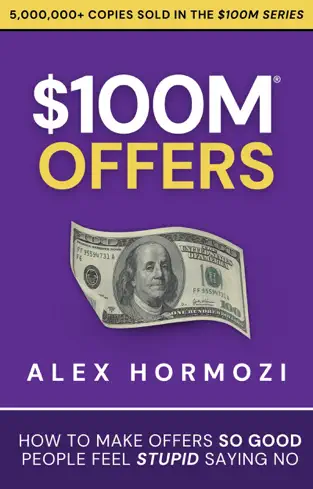
In “$100M Offers,” Alex Hormozi starts with a common business problem: companies sell services that look like their competitors' services and eventually compete on price. His alternative is a “Grand Slam Offer,” a package that combines the desired result, delivery, price, and risk reduction in a form that is difficult to compare directly. An offer is not only the product or the advertisement. It includes everything the buyer expects to receive, how long success may take, how much effort is required, and how credible the promised outcome feels.
Before assembling that offer, Hormozi recommends choosing a market with painful demand, purchasing power, reachable prospects, and enough growth to sustain opportunity. Clever wording cannot rescue a solution nobody wants. The next task is to list the customer's obstacles before, during, and after purchase. Every obstacle becomes a chance to add a solution, proof, or simpler step. This process reverses a common mistake: instead of beginning with the features the company likes to discuss, it begins with the problems the buyer is already trying to solve.
The value equation summarizes the book. Perceived value rises when the dream outcome becomes more desirable and the likelihood of achieving it feels higher. It falls when time delay, effort, and sacrifice increase. An offer can therefore improve without adding a huge content library. Stronger proof, a faster first result, fewer difficult steps, or easier implementation may create more value than another bonus. The equation is not a scientific law; it is a practical prompt that forces the operator to evaluate the experience through the customer's eyes.
After generating possible solutions, Hormozi suggests selecting delivery methods that create high value at a manageable cost. Support can be one-to-one or group-based, live or recorded, done for the customer or supported by tools. The remaining components are stacked into a clear package and named around their results. A strong bonus removes a specific objection. A folder containing dozens of unused files may make the package look larger, but it rarely increases the probability that the buyer will reach the promised outcome.
Pricing should reflect created value rather than labor hours alone. When the outcome is meaningful and confidence is high, a company can move away from commodity comparison. The book also uses scarcity, urgency, bonuses, and guarantees to support the decision. Ethical use requires factual limits: seats must truly be limited, deadlines should not reset every day, and guarantees need understandable terms backed by the ability to honor them. False pressure may increase today's sales while destroying tomorrow's reputation.
A guarantee shifts part of the risk from buyer to seller. It can be unconditional, conditional on completing specific actions, or based on extra service instead of a refund. The correct form depends on how much control the business has over the outcome and how easily the promise can be abused. Social proof, a transparent process, and a clear description of who is and is not a suitable customer can often reduce uncertainty more credibly than an extreme guarantee.
Implementation ends with writing the offer in a clear sentence and testing it at limited scale. Conversion, profit, customer quality, delivered results, and refunds all matter. If the promise attracts unsuitable buyers or exceeds operational capacity, successful advertising only enlarges the failure. The book's strength is its demand that value become easy to understand. A balanced application remembers that an offer cannot repair a poor product and that respecting a customer matters more than making rejection feel embarrassing.
Book and Author Information
Author: Alex Hormozi.
Full title: $100M Offers: How to Make Offers So Good People Feel Stupid Saying No.
Published: Acquisition.com Publishing, 2021.
Page count: about 162 pages in a common digital edition; listed editions range from 154 to 164 pages.
Key Ideas in $100M Offers
Build an offer that is hard to compare
Combine outcome, delivery, and risk reduction to escape pure price competition.
Use the value equation
Increase the desired outcome and confidence while reducing delay, effort, and sacrifice.
Turn obstacles into solutions
Each real customer objection can become a useful part of the offer.
Scarcity and guarantees must be truthful
Long-term trust is worth more than a temporary conversion increase.
Honest Review and Rating
Editorial rating: 4.3 out of 5. The framework is memorable and useful for services, education products, and high-margin offers. The value equation exposes practical opportunities for improvement.
The language is sometimes excessive, and examples lean toward expensive services. Literal use of urgency or guarantees can become manipulative without transparency and reliable delivery.
Frequently Asked Questions
1. What is a Grand Slam Offer?
A distinct package combining an important outcome, suitable delivery, price, and credible risk reduction.
2. What are the parts of the value equation?
Dream outcome, perceived likelihood, time delay, and effort or sacrifice.
3. Should an offer contain many bonuses?
No. Each bonus should answer a real objection or make the result easier.
4. Does the book recommend lowering prices?
It mainly recommends increasing perceived value and differentiating the offer.
5. How should a new offer be tested?
Start small and track conversion, margin, refunds, buyer quality, and actual customer success.
"100 Millions dollars Offers pdf": If it appears on the site in a way that violates copyright, please contact us immediately via the contact form or email to have it removed immediately out of respect for intellectual property rights. Call us: contact@market-books.com
Share the book with your friends


100 Millions dollars Offers pdf
100 Millions dollars Offers pdf مترجم
100 Millions dollars Offers pdf in french
100 Millions dollars Offers pdf en france
100 Millions dollars Offers pdf en français
100 Millions dollars Offers pdf بالفرنسية
100 Millions dollars Offers pdf in English
100 Millions dollars Offers pdf en anglais
100 Millions dollars Offers pdf بالإنجليزية
100 Millions dollars Offers pdf in Arabic
100 Millions dollars Offers pdf en arabe
100 Millions dollars Offers pdf بالعربية
100 Millions dollars Offers pdf in Arabic
100 Millions dollars Offers pdf in English
100 Millions dollars Offers pdf in french
100 Millions dollars Offers pdf in french For free
100 Millions dollars Offers pdf en france For free
100 Millions dollars Offers pdf en français For free
100 Millions dollars Offers pdf بالفرنسية For free
100 Millions dollars Offers pdf in English For free
100 Millions dollars Offers pdf en anglais For free
100 Millions dollars Offers pdf بالإنجليزية For free
100 Millions dollars Offers pdf in Arabic For free
100 Millions dollars Offers pdf en arabe For free
100 Millions dollars Offers pdf بالعربية For free
100 Millions dollars Offers pdf in Arabic For free
100 Millions dollars Offers pdf in English For free
100 Millions dollars Offers pdf in french For free
Books in the same category

Download a book Secrets of the Millionaire Mind pdf

Download a book Pharaohs thieves of civilization pdf

Download a book Act Like a Success Think Like a Success pdf



Download a book The Power of Your Subconscious pdf

Download a book Staying Strong: 365 Days a Year pdf

Download a book The Subtle Art of Not Giving a F*ck pdf




Download a book How to Sell Anything to Anybody pdf





Download the book Full of Emptiness in PDF format

Download the book I Loved and Tomorrow in PDF format

Download the book Know Your Other Face in PDF format







Never Again Will I Be Defeated PDF – Abdullah Mohammed Al-Turki