Summary Kotler on Marketing pdf
Quotes from Kotler on Marketing pdf
review Kotler on Marketing pdf
Kotler on Marketing Summary
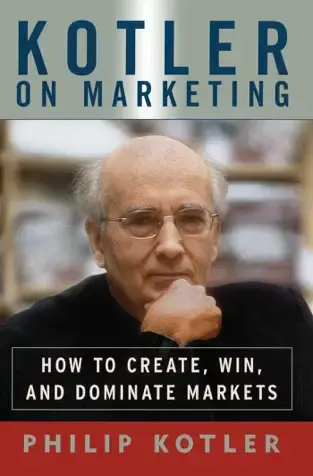
In Kotler on Marketing, Philip Kotler presents marketing as much broader than advertising and sales. Marketing begins before a product is built, when an organization studies needs, alternatives, and forces changing the market, and continues after purchase through experience, relationship, and retention. Selling handles what has already been produced; strong marketing decides for whom value should be created, which problem deserves attention, how to reach the buyer, and how to earn enough to continue. It is therefore a strategic responsibility rather than an isolated promotion department.
Kotler organizes market thinking around research followed by segmentation, targeting, and positioning. A large market contains groups that differ in need, behavior, ability to pay, and route of access. Segmentation is useless when groups cannot be measured, reached, or served effectively. After evaluating size, growth, competitive intensity, and fit with capabilities, the company selects one or more segments. It then defines positioning: the distinctive idea a customer should retain while comparing alternatives. Positioning is not a beautiful slogan; product, price, distribution, service, and actual conduct must prove it.
Strategy is followed by the marketing mix of product, price, place, and promotion. Product includes quality, design, brand, service, and warranty. Price signals value and affects both demand and margin. Place covers access, channels, and inventory. Promotion includes communication, advertising, public relations, and personal selling. The mistake is managing each lever independently. Brilliant advertising for a weak product accelerates disappointment; a low price paired with expensive distribution erases profit; and a promise of convenience contradicted by a complicated buying experience destroys credibility.
Creating, winning, and dominating markets does not have to mean coercive monopoly. Creating identifies an underserved need or redefines a category. Winning means delivering value, trust, and access better than alternatives. Sustaining leadership requires innovation, brand, relationships, distribution, and response because success attracts competitors. Kotler describes strategic roles: a leader protects and expands the category, a challenger selects where to attack, a follower learns at lower cost, and a specialist serves a narrow niche deeply. Not every company benefits from attacking the largest player.
The book also shifts attention from transaction to relationship. Acquiring a new customer is expensive, while a satisfying experience, suitable communication, and reliable service can increase retention and lifetime value. Databases enable personalization and response measurement, but their usefulness depends on data quality and, in modern application, privacy. A brand is a repeatedly fulfilled promise, not merely a name and logo. Every touchpoint, from support employee to package and invoice, either confirms or weakens it. Internal marketing and staff training therefore help create the external reputation.
Kotler translates concepts into a plan covering situation, objectives, strategy, programs, budget, and control. Reach and market share should be joined by profitability, retention, satisfaction, and customer value. A marketing audit challenges assumptions, results, and capabilities instead of automatically renewing last year's budget. When technology, intermediaries, or behavior change, replacing an advertisement may be insufficient; value proposition, channel, and organization may need adjustment. Written during early commercial internet growth, the book recognized that information and relationships would alter buyer power and distribution chains.
The book's strength is combining marketing's pieces into one system and providing strategic vocabulary that remains foundational. Its limitation is that 1999 examples predate social networks, smartphones, large platforms, and modern privacy rules. It is not a ready-made digital advertising or startup growth manual. The word “dominate” can also cause a hurried reader to focus on rivals rather than customers. The best application keeps research, selection, positioning, value, relationships, and measurement, then adds short modern experiments, responsible data practices, and continuous review of changing markets.
Book and Author Information
Author: Philip Kotler, professor and one of the leading theorists of modern marketing.
Full title: Kotler on Marketing: How to Create, Win, and Dominate Markets.
Published: Free Press, 1999.
Page count: about 272 pages in a common English edition.
Main Ideas in the Book
Marketing begins before the product
Research need, customer, and value before investing in promotion.
Segment, target, position
Choose a group and a distinctive idea supported by the entire offer.
Coordinate the marketing mix
Product, price, place, and promotion must tell one deliverable story.
Build relationships and measure profit
Retention, customer value, and execution matter beyond short-term reach and sales.
Honest Review and Rating
Editorial rating: 4.2 out of 5. A structured reference connecting research, strategy, marketing mix, relationships, and control in a coherent system.
It predates platforms and modern privacy rules, so digital examples and tools need substantial updating rather than literal imitation.
Frequently Asked Questions
1. Is marketing the same as advertising?
No. Advertising is one part of a system running from research through experience and retention.
2. What are segmentation, targeting, and positioning?
Divide the market, select a suitable segment, and build a credible distinctive idea.
3. What are the four Ps?
Product, price, place or distribution, and promotion, which must be coordinated.
4. Does dominate mean monopolize?
Here it means sustaining leadership through value and capability, not removing rivals by force.
5. Is the book still useful digitally?
Its strategic principles are useful, but current tools and examples must be added and tested.
"Kotler on Marketing pdf": If it appears on the site in a way that violates copyright, please contact us immediately via the contact form or email to have it removed immediately out of respect for intellectual property rights. Call us: contact@market-books.com
Share the book with your friends


Kotler on Marketing pdf
Kotler on Marketing pdf مترجم
Kotler on Marketing pdf in french
Kotler on Marketing pdf en france
Kotler on Marketing pdf en français
Kotler on Marketing pdf بالفرنسية
Kotler on Marketing pdf in English
Kotler on Marketing pdf en anglais
Kotler on Marketing pdf بالإنجليزية
Kotler on Marketing pdf in Arabic
Kotler on Marketing pdf en arabe
Kotler on Marketing pdf بالعربية
Kotler on Marketing pdf in Arabic
Kotler on Marketing pdf in English
Kotler on Marketing pdf in french
Kotler on Marketing pdf in french For free
Kotler on Marketing pdf en france For free
Kotler on Marketing pdf en français For free
Kotler on Marketing pdf بالفرنسية For free
Kotler on Marketing pdf in English For free
Kotler on Marketing pdf en anglais For free
Kotler on Marketing pdf بالإنجليزية For free
Kotler on Marketing pdf in Arabic For free
Kotler on Marketing pdf en arabe For free
Kotler on Marketing pdf بالعربية For free
Kotler on Marketing pdf in Arabic For free
Kotler on Marketing pdf in English For free
Kotler on Marketing pdf in french For free
Books in the same category


Download a book Secrets of the Millionaire Mind pdf

Download a book Pharaohs thieves of civilization pdf






Download a book Act Like a Success Think Like a Success pdf






Download a book The Power of Your Subconscious pdf

Download a book Staying Strong: 365 Days a Year pdf







Download a book The Subtle Art of Not Giving a F*ck pdf








Download a book How to Sell Anything to Anybody pdf



















Download the book Full of Emptiness in PDF format

Download the book I Loved and Tomorrow in PDF format

Download the book Know Your Other Face in PDF format
























Never Again Will I Be Defeated PDF – Abdullah Mohammed Al-Turki