Summary the book 100 Million Leads PDF
Quotes from the book 100 Million Leads PDF
review the book 100 Million Leads PDF
$100M Leads Summary
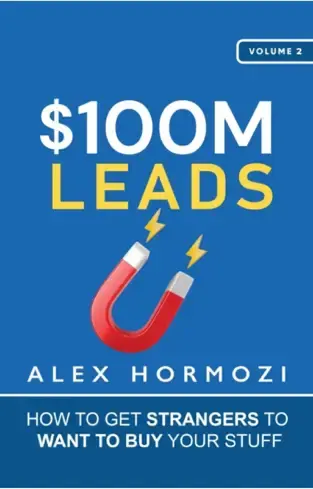
“$100M Leads” assumes that a business already has a worthwhile offer but lacks enough people to see it. Alex Hormozi distinguishes a contact from an engaged lead: a reachable person who has shown meaningful interest. This prevents operators from confusing a large database with a real sales opportunity. Advertising, in his framework, makes more appropriate people aware of the offer and invites a response. The business can then improve the quality of that flow before attempting to multiply volume without understanding what the numbers actually represent.
The book separates warm and cold audiences. Warm people already know the business or trust someone connected to it; cold people have no relationship with it. Hormozi then combines one-to-one and one-to-many communication into the “Core Four”: warm outreach, free content, cold outreach, and paid ads. Platforms change, but these channels remain recognizable. Selecting one and learning it before expanding reduces distraction and helps the operator discover whether the audience, message, offer, or follow-up is responsible for performance.
Warm outreach begins with existing relationships without turning every friend into a target. A good message is personal, asks permission, and opens a conversation instead of immediately sending a payment link. Free content operates one-to-many by teaching, entertaining, or solving a small problem before giving a clear next step. Repetition matters because most followers do not see every post and because confidence is usually built through several useful encounters. One viral post may provide attention, but it does not automatically create trust or qualified demand.
Cold outreach reaches strangers through email, telephone, or direct messages. It requires a relevant list, a contextual opening, a credible reason to talk, and respectful follow-up. Volume without relevance creates complaints and damages reputation. Paid advertising purchases reach rather than consuming the founder's direct time, but it needs a tested offer and reliable tracking. If customer value remains below acquisition cost, increasing the budget does not solve the model. It simply increases the speed at which the company loses money.
A lead magnet is a small solution that helps a prospect diagnose a problem or experience part of a result. It might be a tool, report, test, template, or short training. Its success is not the download count alone; it should move the right person toward a conversation or core offer. A broad giveaway can produce an impressive list with little buying intent. The strongest lead magnet addresses the same problem the paid product solves at a deeper level and demonstrates the company's ability to help.
To move beyond the founder's personal effort, Hormozi discusses lead getters: customers, employees, agencies, and partners or affiliates. Each group can extend acquisition when incentives, instructions, and measurement are clear. Referrals require an experience worth recommending. Employees need a process, agencies need goals and data, and partners need a transparent agreement. Leverage does not mean abandoning control. The business still needs to know where a lead came from, what it cost, whether it fit, and whether it eventually received value.
The Rule of 100 recommends a steady daily volume, such as one hundred outreach attempts or one hundred minutes of content, long enough to learn. Its main value is defeating hesitation and creating data, not turning the number into a universal truth. Responsible use adds privacy law, consent, platform rules, and message quality. The system should be measured through appointments, sales, margin, and retention rather than views alone. The book makes acquisition repeatable, although activity must never replace offer quality or customer experience.
Book and Author Information
Author: Alex Hormozi.
Full title: $100M Leads: How to Get Strangers to Want to Buy Your Stuff.
Published: Acquisition.com, 2023.
Page count: 278 pages in a catalogued English edition; some sales pages list 273 pages.
Key Ideas in $100M Leads
Separate contacts from engaged leads
A large list is not useful unless suitable people demonstrate interest.
Master one of the Core Four
Warm outreach, free content, cold outreach, or paid ads should be learned before expansion.
Connect the lead magnet to the offer
Free value should attract the problem the paid product actually solves.
Use leverage with measurement
Customers, employees, agencies, and partners can generate leads when quality remains visible.
Honest Review and Rating
Editorial rating: 4.2 out of 5. The channel map is practical and encourages enough activity to generate useful feedback. It helps operators who depend on inconsistent referrals.
The emphasis on volume can encourage intrusive or unlawful outreach. The Rule of 100 is not a scientific law and must remain subordinate to audience quality, consent, and unit economics.
Frequently Asked Questions
1. What is an engaged lead?
A suitable person who has clearly shown interest in the offer or the problem it addresses.
2. What are the Core Four?
Warm outreach, free content, cold outreach, and paid advertising.
3. What is a lead magnet?
A small free solution that attracts the right audience and leads logically to the core offer.
4. What is the Rule of 100?
A daily commitment to a high, steady volume of outreach or content creation in order to learn.
5. Which metrics matter most?
Engaged leads, appointments, sales, acquisition cost, margin, and retention.
"the book 100 Million Leads PDF": If it appears on the site in a way that violates copyright, please contact us immediately via the contact form or email to have it removed immediately out of respect for intellectual property rights. Call us: contact@market-books.com
Share the book with your friends


the book 100 Million Leads PDF
the book 100 Million Leads PDF مترجم
the book 100 Million Leads PDF in french
the book 100 Million Leads PDF en france
the book 100 Million Leads PDF en français
the book 100 Million Leads PDF بالفرنسية
the book 100 Million Leads PDF in English
the book 100 Million Leads PDF en anglais
the book 100 Million Leads PDF بالإنجليزية
the book 100 Million Leads PDF in Arabic
the book 100 Million Leads PDF en arabe
the book 100 Million Leads PDF بالعربية
the book 100 Million Leads PDF in Arabic
the book 100 Million Leads PDF in English
the book 100 Million Leads PDF in french
the book 100 Million Leads PDF in french For free
the book 100 Million Leads PDF en france For free
the book 100 Million Leads PDF en français For free
the book 100 Million Leads PDF بالفرنسية For free
the book 100 Million Leads PDF in English For free
the book 100 Million Leads PDF en anglais For free
the book 100 Million Leads PDF بالإنجليزية For free
the book 100 Million Leads PDF in Arabic For free
the book 100 Million Leads PDF en arabe For free
the book 100 Million Leads PDF بالعربية For free
the book 100 Million Leads PDF in Arabic For free
the book 100 Million Leads PDF in English For free
the book 100 Million Leads PDF in french For free
Books in the same category


Download a book Secrets of the Millionaire Mind pdf

Download a book Pharaohs thieves of civilization pdf




Download a book Act Like a Success Think Like a Success pdf





Download a book The Power of Your Subconscious pdf

Download a book Staying Strong: 365 Days a Year pdf






Download a book The Subtle Art of Not Giving a F*ck pdf







Download a book How to Sell Anything to Anybody pdf
















Download the book Full of Emptiness in PDF format

Download the book I Loved and Tomorrow in PDF format

Download the book Know Your Other Face in PDF format