Permission to Feel: naming a feeling is not obeying it
Knowing that a day feels bad is different from knowing what makes it difficult. Are you angry, disappointed, or worried about falling short? Permission to Feel by Marc Brackett makes emotional experience a subject worth examining rather than something to dismiss. A useful question before choosing the book is not how to remain cheerful all the time. It is how to notice a feeling without letting that feeling write the entire response.
This analytical introduction draws on the author’s account, the publisher’s authorised excerpt, Yale’s discussion and official RULER material. It is not a claim to have independently assessed every chapter or the effectiveness of a complete school programme. The focus here is a reader’s everyday problem: finding more precise language while keeping responsibility for what happens next.
What are the five RULER skills?
The official framework describes recognising emotions, understanding their causes and consequences, labelling them accurately, expressing them with attention to context, and regulating responses. These are learnable skills, not a badge awarded to people who never struggle. Recognising disappointment, for example, does not automatically provide the right words for discussing it.
A feeling label should open a question rather than close a case. Saying that an interaction made you angry does not establish what the other person intended. Your interpretation may change when more information becomes available. This distinction helps separate respect for personal experience from certainty about somebody else’s motives.
An original example: a brief work message
Suppose a colleague responds to your carefully prepared document with two words: “Needs revision.” This is our illustrative scenario, not a scene attributed to Brackett. One interpretation is that your work has been dismissed. The information actually available is narrower: the feedback is unclear. Beneath irritation, you might notice uncertainty about the task or disappointment that your effort went unacknowledged.
The next action need not be a long explanation of your feelings. A practical response could ask which section needs changing. If disrespectful comments are a recurring pattern, a separate conversation about communication and boundaries may be needed. Understanding an emotion does not require accepting poor treatment. Afterwards, you could ask whether the exchange clarified the task, improved the relationship, or revealed a problem that still requires attention.
How it compares with Emotional Agility
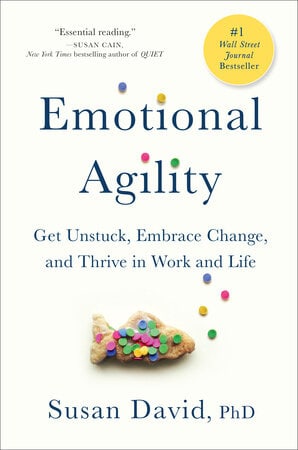
Readers can place this book alongside Susan David’s Emotional Agility. Our editorial comparison treats emotional vocabulary and communication as one entry point, and the relationship between feelings and chosen actions as another. The books overlap, but they are not interchangeable. Start with the question that matters to you rather than assuming that a more famous title must always come first.
A critical reading: language is not enough
Learning an impressive vocabulary changes little if listening habits remain the same. Emotional language can even become another way of blaming people: telling someone they are “bad at feelings” is not the same as understanding them. A productive reading therefore examines your own responses before turning the framework into labels for friends, children or colleagues.
There are also limits beyond individual skill. An unfair workplace cannot necessarily be repaired by naming frustration more accurately. Research on structured educational programmes should not be treated as a guarantee about reading a book alone. The distinction matters because it preserves the value of learning without promising that one framework can remove every social, practical or clinical difficulty.
Checked edition details
The Celadon Books paperback discussed here was published on 4 August 2020: 304 pages, ISBN 9781250212832. The French edition, Permission de ressentir, appeared with Point Nemo on 3 June 2026: 320 pages, ISBN 9782488387910. Jarir records the Arabic Jalees edition at 342 pages. We omit its publication year because catalogue records disagree. Page counts belong to particular editions, not every version of the book.
Five questions before reading
Does permission to feel mean permission to act impulsively?
No. Acknowledging an emotion and choosing a response are separate matters. Responsibility for words and actions remains important.
Is RULER only for children?
The official approach describes emotional skills across ages. Reading an introduction is not equivalent to implementing the complete school programme.
Do I need to memorise a long list of feelings?
The useful aim is greater accuracy and curiosity, not a vocabulary competition or a new system for judging other people.
Can this book replace mental-health care?
No. This is cultural commentary, not diagnosis or treatment. Persistent or disabling distress warrants support from a qualified professional.
Who might find it useful?
A reader willing to examine everyday conversations and practise clearer responses. It is not a shortcut for controlling someone else’s emotions.
Checked references : Author’s introduction · Official RULER skills · Yale School of Medicine discussion · English edition and authorised excerpt · Arabic edition record at Jarir · French publisher Point Nemo