How to Know a Person: listening without rehearsing your reply
You can know someone’s occupation, age and interests without understanding how they see their own life. In How to Know a Person, David Brooks asks about the attention we give other people. Do we treat them as a collection of information, or make room for them to explain what their experiences mean?
The angle here is listening that expands understanding, not a technique for winning every conversation. The title should not be taken as a promise of access to someone’s private thoughts. It opens a question about being present with another person who can still surprise us, correct us or decline to share more.
Author and publication details
David Brooks is a writer and commentator whose books include The Road to Character and The Second Mountain. Random House published the English original on October 24, 2023. The edition whose cover we identify here is the Random House Trade Paperbacks edition dated October 21, 2025: ISBN 9780593230077, 320 pages.
A French edition, Comment connaître vraiment une personne: L’art de créer des liens sincères, is published by Guy Trédaniel. Its publisher lists November 2025, 304 pages and ISBN 9782813235060. These specifications should not be transferred to a large-print edition or a translation whose particular edition has not been checked.
From a label to a story someone can tell
The publisher introduces the book through the possibility of relationships in which people feel recognised and understood. Its official reading guide asks about the difference between hearing and listening, and what stories can reveal beyond separate facts. That is a useful starting point before turning conversation into a collection of ready-made lines.
Our editorial interpretation is that a good question need not sound profound or become intimate. It can simply follow what the speaker has actually said. Asking which part of a difficult day mattered is different from announcing that we already know the cause and inviting the person to confirm it.
A conversation example, not a personality test
Imagine a friend saying that moving to a new job was exhausting. One response is immediately telling your own story about changing jobs. Another is asking which part they want to discuss. After listening, you could check your understanding: was uncertainty harder than the amount of work? They remain free to correct the interpretation or stop there.
This example was developed by our editors; it is not a dialogue taken from the book. Nor does it mean that asking questions guarantees trust. Respecting silence and privacy belongs in a conversation too. Wanting to understand someone does not create an entitlement to a story they do not wish to tell.
Where the approach helps, and where it stops
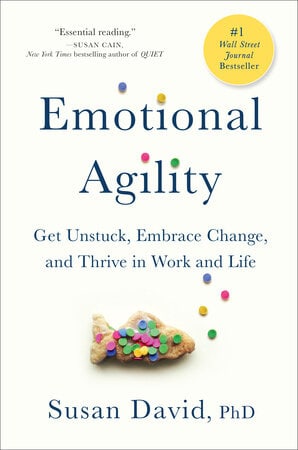
This angle may interest readers who notice themselves rushing towards advice or reducing people to their roles. Readers of Susan David’s Emotional Agility can compare attention to their own inner experience with making room for an experience that is not theirs. That connection does not make the two books interchangeable.
Listening alone cannot resolve every conflict or remove differences in power. Understanding another person’s experience does not require approving harmful behaviour. Empathy does not eliminate boundaries. We therefore do not present this book as a diagnostic tool or a method of controlling other people.
This analytical introduction draws on publisher descriptions, the official reading guide and bibliographic information. It does not claim a personal cover-to-cover review. The examples and critical observations are ours, and no star rating or guaranteed relationship outcome is assigned to the book.
Five questions before reading
Does it promise to reveal what someone thinks?
The title should not be read as a mind-reading promise. Our focus is asking better questions and checking understanding while preserving room for uncertainty and privacy.
Which English edition matches the cover?
The Random House Trade Paperbacks edition with ISBN 9780593230077. The date and page count given above describe that edition rather than every format carrying the title.
Are listening and giving advice incompatible?
Not necessarily. The issue is replacing another person’s account with our solution too quickly. Asking whether they want an opinion or space to talk can clarify what the conversation needs.
Does understanding someone mean agreeing with them?
No. It is possible to understand a context while challenging an action. Conversation does not require abandoning boundaries or continuing an exchange that does not respect them.
Who is this approach for?
Readers interested in examining their everyday conversation habits. If you want a personality test or phrases guaranteed to influence someone, that is not the perspective used in this introduction.
Checked references : English publisher and edition · Official reading guide · French publisher’s edition record