Four Thousand Weeks: a better schedule, or a clearer choice?
A day can contain many completed tasks without making room for what mattered most. In Four Thousand Weeks, Oliver Burkeman uses the limits of a human lifetime to question the ambition of fitting everything into it. The useful question is not simply how to organise a longer list, but what to choose when time cannot accommodate every possibility.
The title offers a scale: a life lasting eighty years contains roughly four thousand weeks. It is not an individual lifespan prediction or a personal countdown. Treating it as a demand to make every minute extraordinary would add another obligation to the very expectations the book invites readers to reconsider.
Author and edition details
Burkeman writes about time, productivity and the limits of control. The original English book appeared in 2021. The edition identified here is the Picador trade paperback, ISBN 9781250849359, published on June 27, 2023, with 304 pages. These details belong to that edition, not to every format sharing the title.
The French Pocket edition, ISBN 9782266354950, is listed by France’s national library at 320 pages with an August 20, 2026 publication date. Jarir lists an Arabic edition from Arab Scientific Publishers at 286 pages and a 2021 publication year. Different page counts do not by themselves establish an abridgement or tell us which translation is better.
What acknowledging limits changes
In his introduction to the book, Burkeman challenges the pursuit of a future moment when everything will finally be done. The publisher’s public excerpt also examines a relationship to time in which the present is continually judged by its usefulness for something later. This questions what we expect organisation to achieve; it does not require abandoning all planning.
Our editorial interpretation separates an ordering problem from a capacity problem. A clearer calendar may help with the first. With the second, commitments already exceed the time available, and moving them around cannot create another week. This distinction is a way of exploring the premise, not a formula attributed to a particular chapter.
A list waiting for a decision, not an app
Imagine someone planning to learn a language, finish three books and launch a side project in one month, alongside paid work and family responsibilities. Instead of dividing every evening into tiny pieces, they could choose one active project and explicitly postpone the others. Postponement does not make the remaining projects worthless; it recognises that value does not create simultaneous capacity.
This is an example developed by our editors, not an exercise reproduced from the book. It is not universally available advice. Employees and carers may have little control over their obligations. Some limits call for negotiation, support or organisational change rather than a different personal attitude. A discussion of choice should not become a judgement on people with fewer choices.
Reading it alongside Slow Productivity
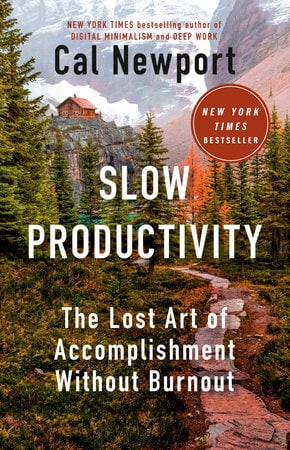
Readers of Cal Newport’s Slow Productivity can compare the rhythm of work with the broader question of our relationship to time. Before designing a method, ask which worthwhile activity you are willing not to pursue now. That question gives a practical meaning to priority rather than treating every appealing possibility as an active promise.
The strength of this angle is that it does not equate the value of a life with a task count. Its limitation is that reflection alone cannot remove imposed deadlines or unequal power. This page is an analytical introduction based on author and publisher descriptions and a public excerpt, not a claim of a personal cover-to-cover review. It supplies neither a numerical rating nor a guaranteed life outcome.
Five questions before choosing the book
Is it a daily scheduling manual?
Its concern extends beyond calendar techniques. If you need a precise routine, inspect the contents and excerpt to decide whether this broader reflection matches that need.
Does accepting limits mean giving up ambition?
It can mean defining a workable field of action instead. The practical question is which ambition receives real time, rather than how many ambitions can be declared simultaneously.
Is four thousand weeks a guaranteed average lifespan?
No. It is a rough calculation conditional on living to eighty, not an estimate of any individual reader’s remaining life.
Which English edition is described here?
The 2023 Picador paperback with ISBN 9781250849359. Check your own copy’s publication page before transferring its date or page count to another format or language.
What is a useful first step after this overview?
Name one commitment you want to give time to and one you can safely postpone. Then read the publisher’s excerpt and consider whether its question is one you want to explore further.
Checked references : Author’s introduction · English publisher and excerpt · Arabic edition record at Jarir · French national library: Pocket edition