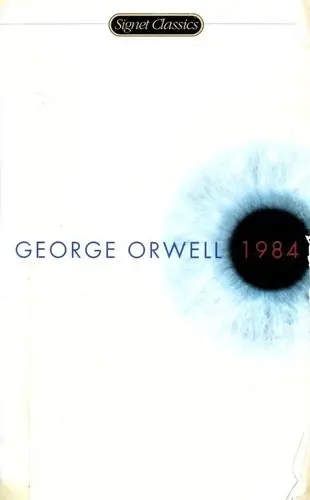
Summary 1984 by George Orwell pdf
Quotes from 1984 by George Orwell pdf
review 1984 by George Orwell pdf
Book summary: Nineteen Eighty-Four
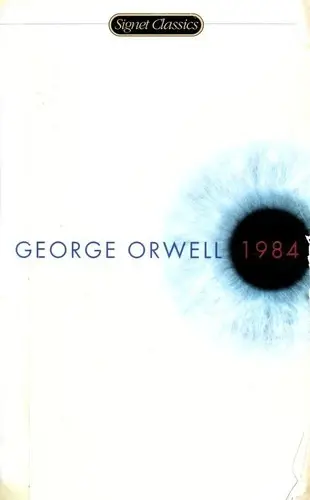
The novel takes place in Oceania, a totalitarian state that watches citizens through telescreens and imposes Big Brother on public and private life. Winston Smith works at the Ministry of Truth, rewriting old newspapers so the past agrees with whatever the Party says today. His job traps him inside a daily contradiction: he knows the record changed because he helped change it, yet the system requires him to accept the new version and forget the act of falsification. His rebellion begins in a small, dangerous space—the effort to keep one thought and memory that do not belong to the Party.
This world is built from reversals of language and function. The Ministry of Truth produces lies, Love manages repression, and Peace manages war. The purpose is not temporary deception but the removal of an independent standard for naming reality. Doublethink is the ability to hold two contradictory beliefs and forget the contradiction when required. Newspeak reduces vocabulary to narrow the range of expressible ideas. Orwell does not claim language controls the mind like a simple machine, but shows how lost precision makes resistance harder and lets slogans replace argument.
Winston searches for contact with truth through memory, objects, and relationships. A fragment from the past or conversation with an older person might provide evidence of life before the regime, yet private memory is fragile. His relationship with Julia creates desire and privacy in a society seeking to organize bodies and emotion, making intimacy political. The novel does not make heroism easy. Fear, isolation, and the absence of reliable information leave resistance vulnerable to manipulation. The Party wants more than outward obedience; it seeks power over a person’s interpretation of self.
Power in 1984 is not a tool for welfare or even stable doctrine. It becomes an end that reproduces itself. Permanent war consumes surplus and preserves fear, surveillance turns every person into a guard over themselves, and altered history removes alternatives for comparison. The novel asks a frightening question: if an institution controls records, language, punishment, and relationships, how can the claim that two plus two equals four remain socially meaningful? Reality does not disappear because power punishes those who name it, but protecting truth requires institutions, memory, and collective courage.
The novel’s power lies in its world and vocabulary, which became tools for understanding propaganda and surveillance. It is not a literal prediction of every technology or policy. Calling every disagreement “Orwellian” empties the term; the fictional state combines comprehensive surveillance, torture, organized falsification, and information monopoly. Some characters function more as carriers of ideas than fully developed people, and the novel’s treatment of sex and class invites criticism. It remains a severe literary defense of a person’s right to memory, language, and truth that does not change by political order.
A clearer view of “Nineteen Eighty-Four” emerges when the summary is organized around four connected themes: «Control of the past», «Language shapes precision», «Surveillance becomes internal», «Truth needs collective protection». In theme 1, Altered records prevent people from comparing propaganda with reality. In theme 2, Reduced vocabulary and slogans weaken the ability to formulate resistance. In theme 3, The possibility of observation makes people police themselves. In theme 4, Private memory is fragile against a monopoly of records and force. These themes are not isolated rules. They are lenses for understanding the argument, the characters’ movement, and the consequences the work asks readers to consider. While reading, it helps to record the central claim in each part, the example supporting it, and the question still unanswered, then compare those notes with personal experience or an independent source whenever historical or scientific facts are involved. This prevents an attractive phrase from becoming a universal truth and separates what the author actually states from what the reader infers. With a practical nonfiction book, one idea can be tested for a week, with results and obstacles recorded before the method is adjusted; trying everything at once makes evaluation impossible. With fiction, the equivalent test is to track changes in character, the narrator’s reliability, and whether the ending answers the tensions the plot created. A final three-sentence note—main insight, strongest objection, and one action or question worth pursuing—makes the reading easier to retain without exaggerating the book’s promises or dismissing its value. The book then becomes the beginning of a revisable conversation shaped by context, goals, and edition, not a closed recipe or a collection of quotations.
Book and author information
Author: George Orwell, the pen name of Eric Arthur Blair (1903–1950).
Original title: Nineteen Eighty-Four.
First published: Secker & Warburg, 1949.
Length: varies by edition; many modern English editions run about 320–336 pages.
Key ideas
Control of the past
Altered records prevent people from comparing propaganda with reality.
Language shapes precision
Reduced vocabulary and slogans weaken the ability to formulate resistance.
Surveillance becomes internal
The possibility of observation makes people police themselves.
Truth needs collective protection
Private memory is fragile against a monopoly of records and force.
Review and rating
Editorial rating: 4.8 / 5.
A powerful, coherent novel that created a lasting vocabulary for understanding totalitarian control and reality manipulation.
Some characters are more symbolic than psychologically rich, and “Orwellian” should not become a lazy comparison for every disagreement or digital service.
Frequently asked questions
1. Is 1984 based on a true story?
It is fiction informed by Orwell’s experience of propaganda and twentieth-century totalitarianism.
2. Who is Big Brother?
The Party’s image of leadership and permanent presence; whether he is one real individual remains uncertain.
3. What is Newspeak?
A designed language that reduces vocabulary to make certain thoughts harder to express.
4. Is the novel only about surveillance?
No. It also concerns memory, language, truth, love, torture, and power itself.
5. Does this summary spoil the ending?
No. It presents the world and themes without revealing the final outcome.
"1984 by George Orwell pdf": If it appears on the site in a way that violates copyright, please contact us immediately via the contact form or email to have it removed immediately out of respect for intellectual property rights. Call us: contact@market-books.com
Share the book with your friends


1984 by George Orwell pdf
1984 by George Orwell pdf مترجم
1984 by George Orwell pdf in french
1984 by George Orwell pdf en france
1984 by George Orwell pdf en français
1984 by George Orwell pdf بالفرنسية
1984 by George Orwell pdf in English
1984 by George Orwell pdf en anglais
1984 by George Orwell pdf بالإنجليزية
1984 by George Orwell pdf in Arabic
1984 by George Orwell pdf en arabe
1984 by George Orwell pdf بالعربية
1984 by George Orwell pdf in Arabic
1984 by George Orwell pdf in English
1984 by George Orwell pdf in french
1984 by George Orwell pdf in french For free
1984 by George Orwell pdf en france For free
1984 by George Orwell pdf en français For free
1984 by George Orwell pdf بالفرنسية For free
1984 by George Orwell pdf in English For free
1984 by George Orwell pdf en anglais For free
1984 by George Orwell pdf بالإنجليزية For free
1984 by George Orwell pdf in Arabic For free
1984 by George Orwell pdf en arabe For free
1984 by George Orwell pdf بالعربية For free
1984 by George Orwell pdf in Arabic For free
1984 by George Orwell pdf in English For free
1984 by George Orwell pdf in french For free
Books in the same category

Download A novel in my heart is a female Hebrew pdf

Download a Novel 11:11 A myth is better than a thousand facts pdf