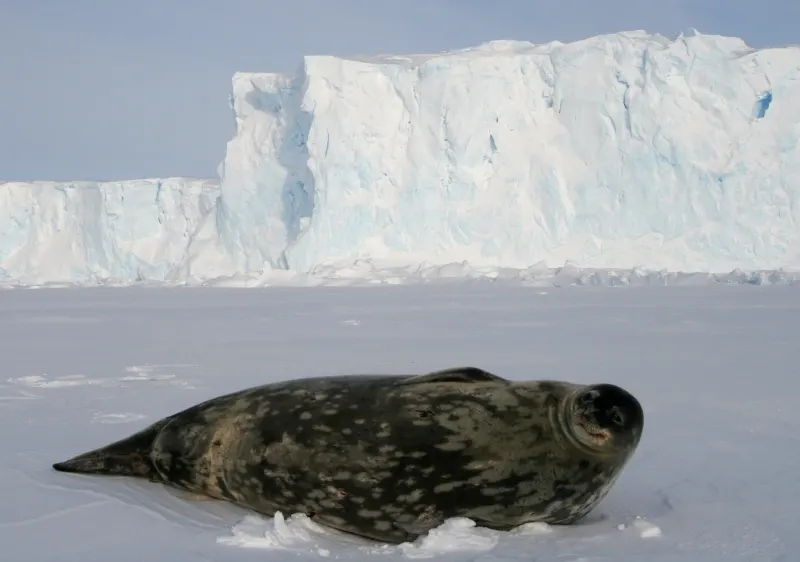
The seasonal story inside a seal’s silhouette
WHOI’s 26 November 2026 announcement presents a Science review combining drone imagery and physiology. Weddell mothers lose fat and lean tissue while nursing, then rebuild lean tissue first after weaning. Aerial body dimensions alone cannot distinguish those changes reliably.
That makes a larger outline an intriguing observation, not a complete account of recovery. The biological question concerns what the animal is rebuilding. For this story, treating every increase as replenished fat would erase the very distinction that makes the seasonal sequence interesting.
Earlier research reveals contrasting summer trajectories
A separate study published online in March 2025 compared mothers with females that skipped pupping in McMurdo Sound. Its abstract reports that mothers regained mostly lean tissue after weaning, while the other group lost mass and lipid across summer.
The comparison changes the question from « which animal is bigger? » to « where is each animal in its reproductive and seasonal cycle? » Putting both groups under one simple weight trend could obscure opposite trajectories. This earlier finding supplies context for the new review; it is not an experiment newly conducted this week.
What the measurements keep separate
The accompanying Dryad dataset was published on 20 October. Its dictionary distinguishes reproductive status, seasonal timing, body mass, lipid mass and lean mass. It also records ultrasound blubber measurements. Missing entries can reflect field logistics or measurements added in later years.
Those fields offer a much richer picture than a single outline: comparisons can specify not only the animal but also the stage and the quantity being compared. A blank entry is not evidence that a tissue or seasonal change was absent.
An example: the same gain, different recovery
Imagine a seal gaining five kilograms. In one invented scenario, most of the increase is lean tissue; in another, most is fat. The total gain is identical, but the composition question has different answers. These are illustrative quantities, not results from either publication.
The useful role of the aerial view is therefore not diminished by needing another kind of measurement. A photograph offers a broad view; composition evidence helps explain what a changing outline represents. The review’s conservation interest lies in combining those strengths, rather than choosing between remote observation and physiology. It does not establish a single diagnostic recipe for every species, age or season.