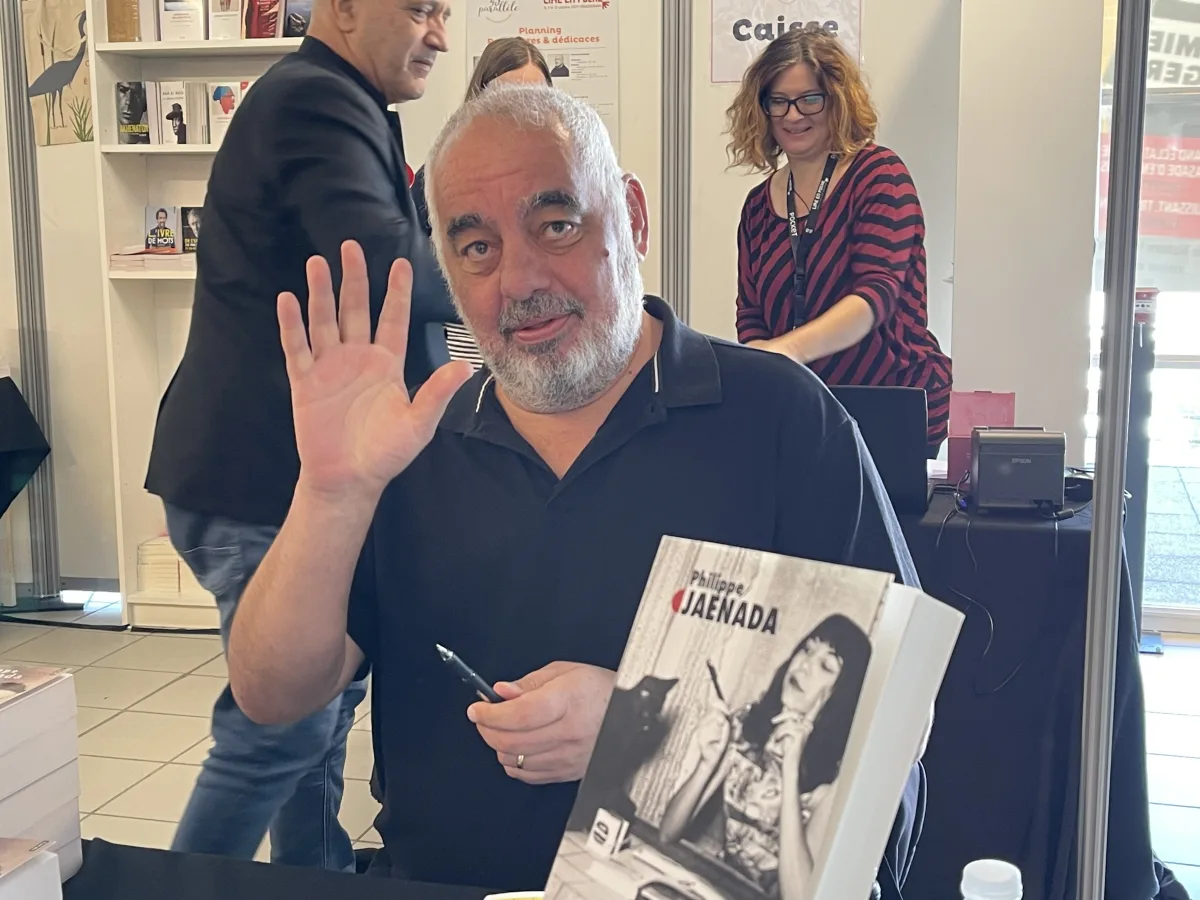
The 2026 Prix Goncourt went to Philippe Jaenada for L’inconnue du quai de Javel on 3 November at Drouant in Paris. The official announcement records a first-ballot decision, with six votes against three for Sylvain Prudhomme. Ten days later, the useful cultural question is what that decision brings into view, rather than how to make the ceremony sound as though it happened today.
The Bibliothèque nationale de France confirms Flammarion as the original publisher and places Jaenada’s work within a practice of investigating old cases through documents. That institutional context takes us beyond the award label. It does not independently verify every argument in the book, and it is not a claim that this article follows a complete reading of the novel.
From the name of a case to a person’s life
Gallimard’s official catalogue for the audio edition introduces the murder of Louise Cansot, a model for Montparnasse painters found dead in Paris in 1949. It describes Jaenada returning to the file and its locations decades later. We stop at that premise, without revealing his eventual hypothesis or converting a publisher’s promise of resolution into news of a judicial finding.
A question opens beyond the identity of a killer: how can a person reduced to a victim or an unknown woman regain a history? What can be known about her life, what remains missing and who originally had the power to describe her? These are editorial reading questions prompted by the subject, not verdicts on how successfully the complete book answers them.
Documents do not tell a story unaided
An archive does not remove the choices of the person using it. A writer selects a beginning, places one detail beside another and decides when to pause, explain or doubt. The useful distinction is therefore not simply between books with documents and books without them. It concerns how knowledge is built and how its limits are made visible.
Readers can separate a fact established by a record, an interpretation proposed by the writer and a scene that makes the past feel present. Smooth narration does not give all three the same evidential weight. A passage may persuade through rhythm or sympathy; a historical assertion requires another question about its source and what that source can support.
The BnF describes Jaenada as an intensive user of Gallica and reports that he encountered the case while browsing its digitised newspapers. That gives a concrete example of collections serving more than academic research. It does not make an old newspaper transparent evidence: its language can preserve the assumptions, prejudices and omissions of its own time.
Curiosity need not turn suffering into spectacle
A reader may begin with a mystery and gradually shift attention towards a person. Which details help explain an existence, and which risk making it an object of intrusive interest? Asking that does not prohibit writing about violence. It distinguishes an attempt at human understanding from the consumption of a case as entertainment alone.
Empathy does not license invented certainty either. Imagining what a document leaves unsaid may have a literary role, provided the act remains recognisable. A group could compare a moment of doubt with one of confident assertion: has the evidence changed, or only the narrative tone? That is a suggested approach, not a comparison we claim to have completed across the entire text.
An award supports discovery, not a final conclusion
The Académie’s published conditions concern fiction written in French and issued by a Francophone publisher with bookshop distribution. The Goncourt is therefore not a prize for the best book translated into French. Knowing an award’s scope prevents different literary selections from being flattened into one universal ranking.
Edition details matter as well. The original print book is associated with Flammarion, while Gallimard records an audio version; different publisher names can identify different formats rather than a contradiction. Checking the particular edition and trying an authorised sample keeps readers active. Discovering a prizewinner does not require promising to agree with the jury’s decision.
Two important distinctions
Does this article announce an official solution to the crime?
No. It introduces a literary investigation without claiming that a court judgment or a new judicial proceeding follows from it.
Is this a complete review of the novel?
No. It uses the Academy’s announcement, institutional sources and the audio publisher’s catalogue to propose reading questions, not replace reading the work.