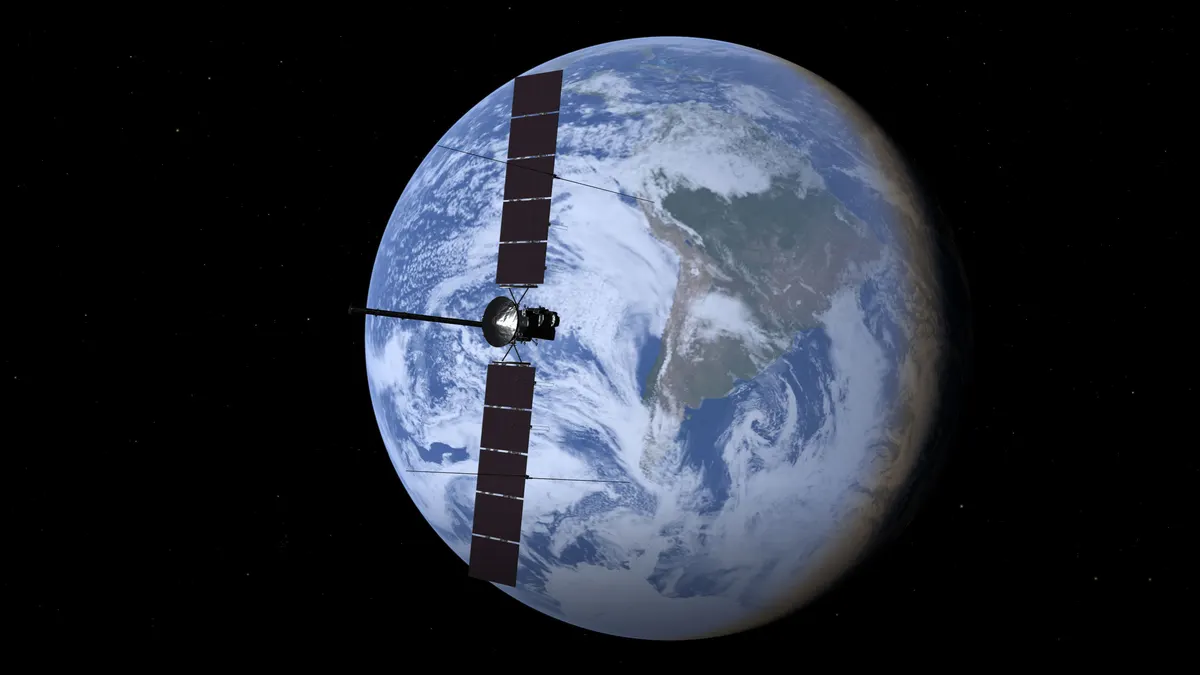
A homecoming that points outward
NASA’s 25 November 2026 announcement sets Europa Clipper’s Earth flyby for 3 December. A gravity assist will redirect it toward Jupiter while saving propellant; all nine instruments will collect calibration data for comparison with known Earth measurements.
The apparent contradiction is the attraction of this encounter: returning toward home can be part of going farther away. A mission route is not simply a line joining its departure point to its destination. The journey must also deliver the right motion. Earth consequently appears in this story as both a turning opportunity and a familiar subject for the science team.
Why gravity can help without being an engine
NASA’s spaceflight primer explains that a moving planet can exchange orbital momentum with a spacecraft. Its gravity bends the flight path, changing the spacecraft’s Sun-relative velocity. Depending on the geometry, an encounter can increase or decrease orbital energy.
This is why the phrase « gravity assist » is more informative than a picture of a spacecraft dropping toward a planet. The useful effect is not merely going faster during approach. It concerns the outgoing journey. Thinking in terms of a carefully shaped route makes the return visit less mysterious: the detour belongs to the transport plan, not a reversal of the mission’s purpose.
One encounter, several kinds of science
The instrument overview gives those preparations a concrete destination. A magnetometer investigates Europa’s ocean through magnetic measurements; thermal imaging seeks warmer surface regions. The mission examines potentially habitable conditions, rather than carrying instruments that directly identify life.
Those different questions explain why an instrument rehearsal matters alongside navigation. Reaching a destination and interpreting a measurement there are separate achievements. A spacecraft can follow its route while scientists still need to understand precisely what its instruments report.
A short example of the scientific payoff
Imagine a later calibration comparison finds an unexpected magnetic reading. This is an illustrative scenario, not a reported result. Its first value would be understanding the measurement system; it would not, by itself, reveal anything about a distant ocean. That distinction makes the rehearsal interesting in its own right.
For now, the encounter is still ahead. The next substantial development will be what the team actually obtains, not simply another illustration of the planned pass. Earth’s role in this journey joins two ambitions: helping the craft travel and helping its eventual observations become intelligible.