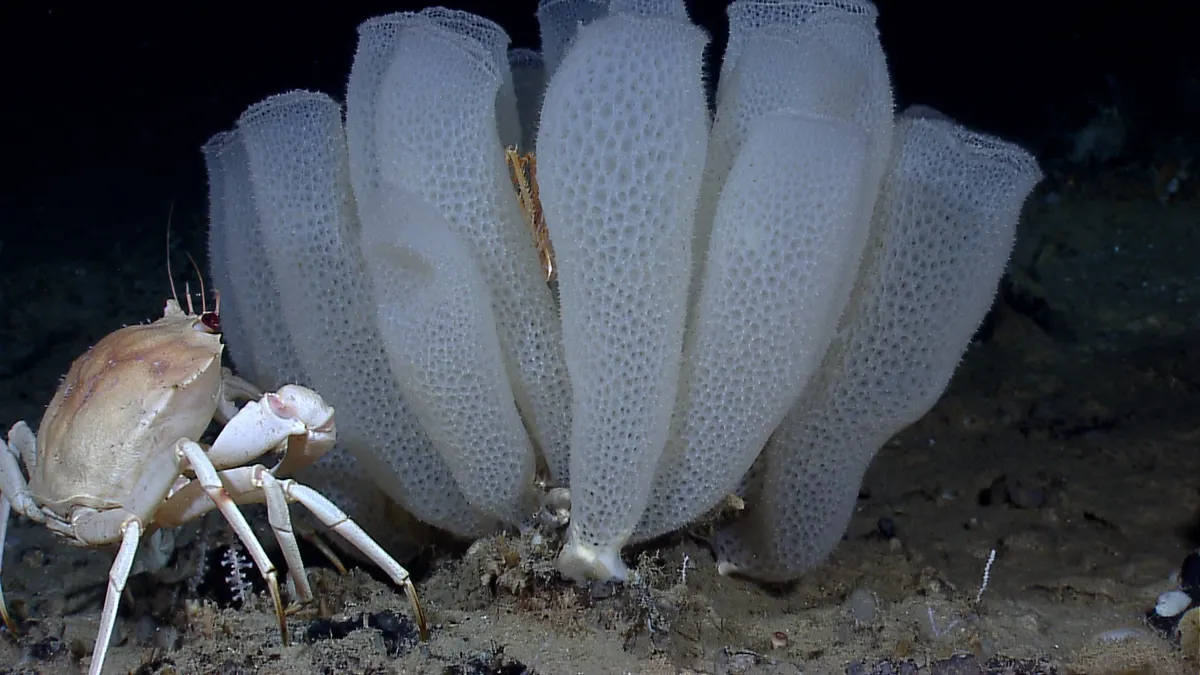
A resource published in Scientific Data on November 23, 2026 brings together 1,719 reconstructed microbial genomes from 27 metagenomes spanning 17 deep-sea sponge species. The new development is a scientific publication, not 1,719 newly discovered animals or samples all collected today.
This introduction follows the published abstract, not an independent audit of every file. A library catalogue provides a useful analogy: it organises material for later questions without equalling a reading of every book or proof of every idea.
A sample contains more than its photograph shows
Seeing a sponge does not reveal its entire associated microscopic community. With genetic data, distinguish the sampled organism from sequences attributed to microorganisms associated with it. A photograph shows a setting or shape, not the genomes themselves.
Notice the levels of work: sample, sequence read, reconstructed genome and interpretation. These are not interchangeable names. They describe stages whose assumptions and limitations can influence a result.
A catalogue opens a possibility, not a completed experiment
A sequence resembling something linked to a known function may suggest a research question. That alone does not demonstrate the same activity in the natural environment. Inferred potential and directly measured activity remain different kinds of evidence.
For an educational comparison, a catalogue title suggests a subject without establishing how an author develops an argument. Organised resources become more valuable when researchers can inspect how they were built and where their use is limited, rather than treating scale as a universal promise.
Read a dataset announcement without specialist training
Ask what each number counts: species, samples, sequences or files. Look for provenance, access conditions and a description of quality. Making observations comparable can matter even before a dramatic application emerges.
Do not turn a genetic library into a promise of a medicine or product absent from the paper. Its immediate contribution is enabling more precise later questions. Sometimes a discovery begins with a quiet tool that improves how knowledge is organised and checked.